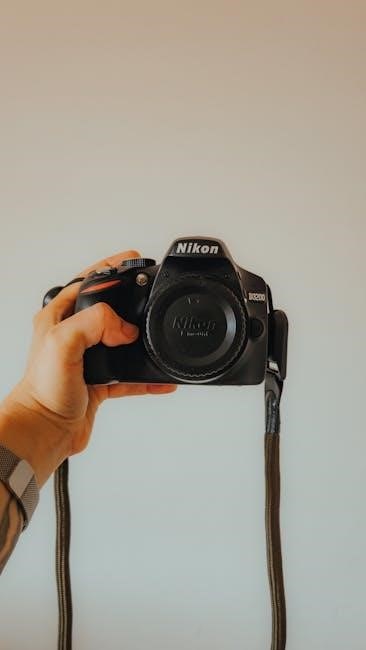
Congratulations on acquiring the Nikon D3300! This guide, derived from the official manual, will unlock its potential. Download the PDF for detailed instructions and enjoy photography!
The D3300 offers a fantastic entry into DSLR photography, boasting a user-friendly interface and impressive image quality. Explore the manual for optimal use.
What’s in the Box
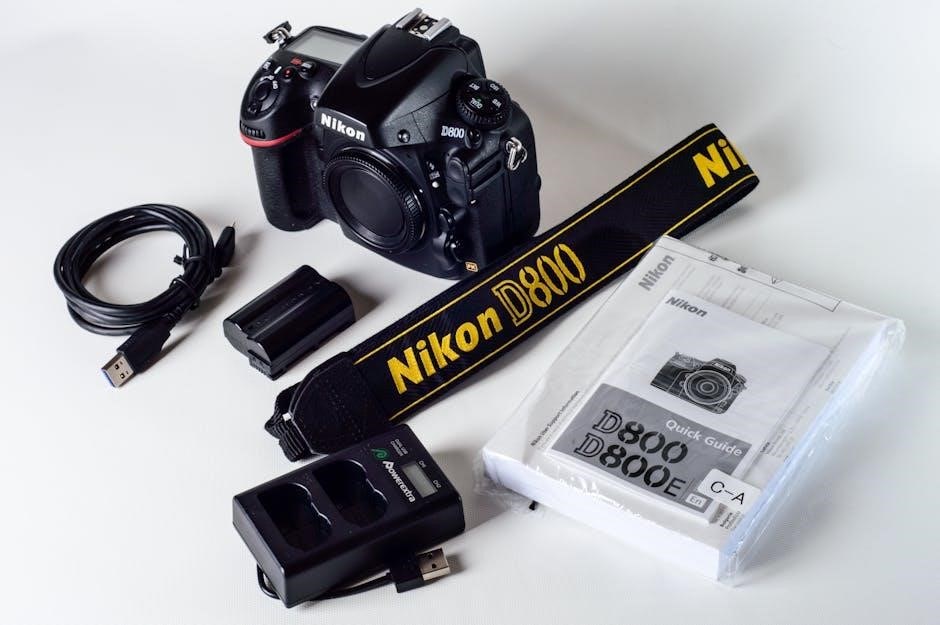
Upon unboxing your new Nikon D3300, you’ll find several essential components. These include the D3300 camera body itself, an 18-55mm VR kit lens, and a battery charger. A rechargeable Li-ion battery is also included, providing power for your photographic adventures.
Furthermore, the package contains a USB cable for transferring images to your computer, and a strap for comfortable carrying. You’ll also receive documentation, including the Reference Manual in PDF format, offering comprehensive instructions. Finally, a body cap and lens cap are provided for protection when not in use.
Key Features of the D3300
The Nikon D3300 boasts a 24.2-megapixel DX-format CMOS sensor, delivering exceptional image detail and clarity. Its EXPEED 4 image processor enhances performance and reduces noise, especially in low-light conditions. The camera features 11-point autofocus for accurate subject tracking.
A standout feature is its Guide Mode, simplifying settings for beginners, as detailed in the manual. Full HD 1080p video recording is also supported. Connectivity options include built-in Wi-Fi for easy image sharing. Refer to the PDF manual for complete instructions.

Getting Started
Begin your journey with the Nikon D3300 by consulting the manual! Prepare to charge the battery, insert it correctly, and attach your chosen lens.
Charging the Battery
Before first use, fully charge the EN-EL14a battery. Connect the supplied power adapter and cable to the battery charger, then insert the battery.
The charger’s CHARGE lamp will illuminate red during charging. Once fully charged, the lamp turns off. Refer to the manual for charging times—approximately 2 hours are typical.
Avoid interrupting the charging process. The manual details safety precautions; always use the specified Nikon charger to prevent damage or malfunction. A fully charged battery ensures optimal performance.
Inserting the Battery
To insert the EN-EL14a battery, locate the battery compartment on the camera’s bottom. Slide the battery compartment latch away from the camera body. Ensure the battery’s contacts align with those inside the compartment.
Gently push the battery in until it clicks into place. Confirm it’s securely fastened. Slide the latch back to lock the battery. The manual emphasizes proper insertion to avoid damage.
Incorrect insertion may prevent the camera from powering on. Always refer to the manual’s diagrams for visual guidance.
Attaching the Lens
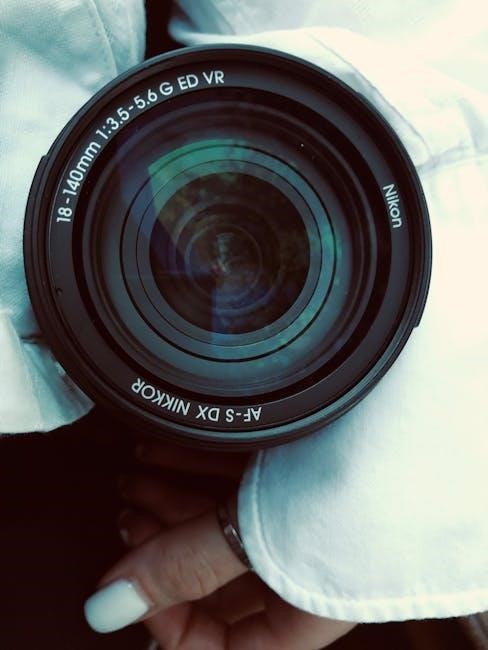
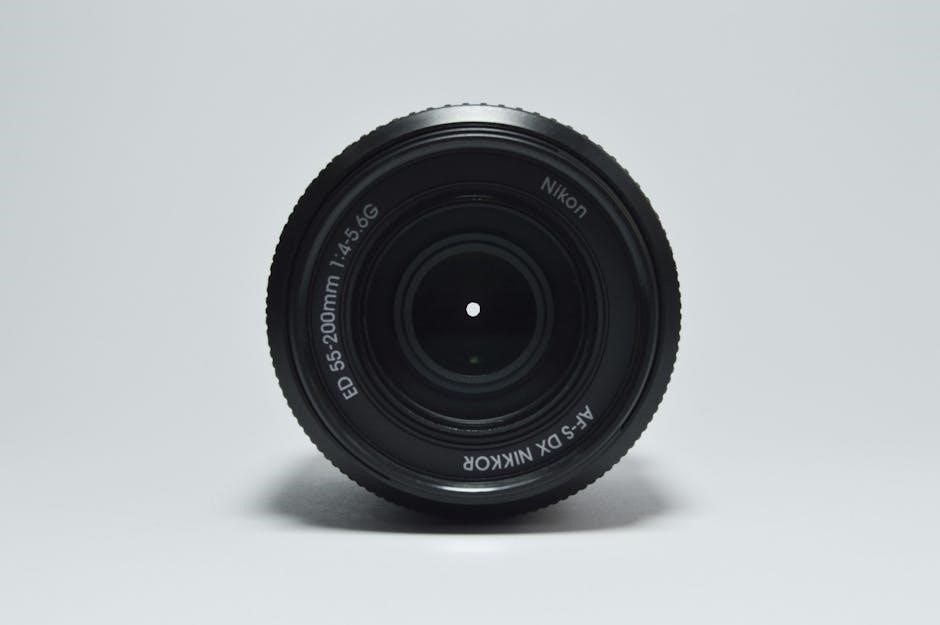
To attach a compatible Nikon lens, align the lens mounting index with the body’s corresponding mark. Gently insert the lens into the mount, ensuring it doesn’t force. Rotate the lens clockwise until it clicks securely into place.
The manual stresses avoiding excessive force. To detach, press the lens release button on the camera body while rotating the lens counterclockwise. Store lenses carefully to protect the glass.
Always consult the manual for specific lens compatibility and proper mounting techniques. Incorrect attachment can damage both the camera and the lens.
Understanding the Camera Interface
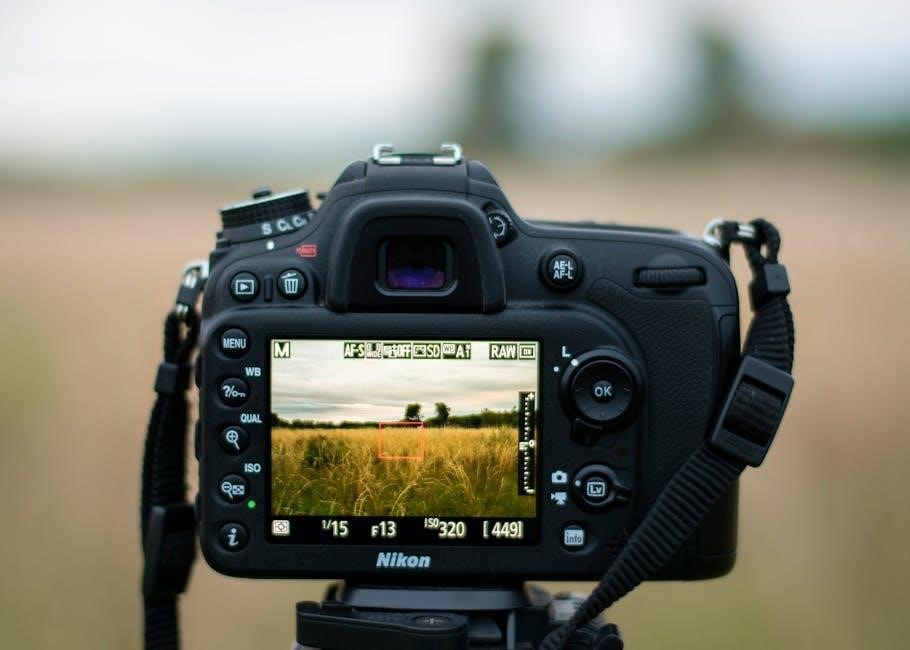
Familiarize yourself with the D3300’s controls! The manual details the Mode Dial, buttons, and LCD screen, essential for navigating settings and capturing stunning images.
The Mode Dial
The Mode Dial, prominently located on top of the D3300, is your primary control for selecting shooting modes. As detailed in the manual, options include Auto, Scene, Manual, and more.
Auto mode simplifies shooting, while Scene modes offer presets for landscapes, portraits, and other scenarios. For full creative control, explore Manual mode, adjusting aperture and shutter speed. The manual provides in-depth explanations of each mode, enabling you to tailor settings to your photographic vision. Understanding these modes is crucial for mastering your D3300.
Control Buttons and Dials
The Nikon D3300 features several buttons and dials for precise camera control, as outlined in the manual. The Command dial adjusts settings like aperture and shutter speed in Manual mode.
Dedicated buttons provide quick access to functions like ISO, white balance, and autofocus. The manual details each button’s function, ensuring efficient operation. Mastering these controls allows for swift adjustments without navigating menus. Familiarize yourself with their placement and purpose for a seamless shooting experience and enhanced creativity.
The LCD Screen
The Nikon D3300’s LCD screen serves as your viewfinder and image review portal, detailed in the manual. It displays shooting information, menu options, and captured images. Brightness is adjustable for optimal viewing in various lighting conditions.
Use the LCD to navigate menus, review photos, and even compose shots using Live View. The manual explains how to utilize the screen’s features effectively. Understanding the LCD’s display will significantly enhance your shooting workflow and image assessment capabilities.
Basic Shooting Settings
Explore Auto, Scene, and Manual modes, explained in the manual. Master aperture, shutter speed, and ISO for creative control over your Nikon D3300’s images.
Shooting Modes (Auto, Scene, Manual)
The Nikon D3300 offers versatile shooting modes to suit every photographer. Auto mode simplifies operation, letting the camera handle all settings for effortless pictures. Scene modes, detailed in the manual, optimize settings for specific situations like portraits, landscapes, or sports.
For complete control, explore Manual mode. This allows you to independently adjust aperture, shutter speed, and ISO, fostering creativity and understanding of photographic principles. The manual provides in-depth guidance on utilizing each mode effectively, ensuring you capture stunning images tailored to your vision. Experiment to discover what works best!
Understanding Aperture
Aperture, detailed in the Nikon D3300’s manual, controls the lens opening, influencing both brightness and depth of field. A wider aperture (lower f-number like f/2.8) lets in more light, creating a shallow depth of field – ideal for portraits with blurred backgrounds.
Conversely, a narrower aperture (higher f-number like f/16) reduces light intake and increases depth of field, keeping more of the scene sharp – perfect for landscapes. Mastering aperture, as explained in the manual, is crucial for achieving creative control over your images.
Understanding Shutter Speed
Shutter speed, thoroughly explained in the Nikon D3300’s manual, determines how long the camera’s sensor is exposed to light. Faster shutter speeds (e.g., 1/1000s) freeze motion, excellent for sports or wildlife photography. Slower shutter speeds (e.g., 1/30s) allow more light in, useful in low-light situations.
However, slower speeds can cause motion blur if the camera or subject moves. The manual details how to balance shutter speed with aperture and ISO for properly exposed and sharp images. Experimentation is key to mastering this vital setting!
ISO Sensitivity Explained
ISO, as detailed in the Nikon D3300’s manual, controls your camera’s sensitivity to light. Lower ISO settings (e.g., ISO 100) produce cleaner images with less noise, ideal for bright conditions. Higher ISO settings (e.g., ISO 3200) are useful in low light, but introduce more noise or grain.
The manual advises finding a balance – using the lowest ISO possible to maintain image quality. Understanding ISO’s impact is crucial for achieving well-exposed photos in various lighting scenarios. Experiment to find your preferred settings!
Focusing and Metering
Refer to the Nikon D3300 manual for detailed explanations of autofocus modes, focus areas, and metering options. Master these for sharp, well-exposed images!
Autofocus Modes
The Nikon D3300 offers several autofocus (AF) modes, detailed in the manual, to suit various shooting scenarios. AF-S (Single Servo) is ideal for stationary subjects, focusing once when the shutter button is half-pressed. AF-C (Continuous Servo) tracks moving subjects, continuously adjusting focus.
AF-A (Automatic Servo) automatically switches between AF-S and AF-C, attempting to determine the best mode. Understanding these modes, as explained in the manual, is crucial for capturing sharp images. Experiment with each to find what works best for your photographic style and subject matter.
Focus Area Modes
The Nikon D3300’s manual details several Focus Area Modes, influencing where the camera focuses. Single-point AF lets you select a specific focus point for precise control. Dynamic-area AF uses the selected point, plus surrounding points, to track moving subjects.
Auto-area AF allows the camera to automatically select focus points, useful for general photography. 3D-tracking maintains focus on a moving subject as it moves across the frame. Refer to the manual for visual guides and to understand how each mode impacts image sharpness.
Metering Modes
The Nikon D3300 manual explains three Metering Modes, crucial for proper exposure. Matrix metering evaluates the entire scene for balanced exposure, ideal for most situations. Center-weighted metering prioritizes the center of the frame, useful for portraits.
Spot metering measures light from a very small area, perfect for challenging lighting. Understanding these modes, as detailed in the manual, allows you to control how the camera interprets light and ensures correctly exposed images. Experiment to find what works best!
Advanced Shooting Techniques
The Nikon D3300 manual unlocks creative control! Explore Manual mode, White Balance adjustments, and Picture Control settings for stunning, personalized images.
Using Manual Mode
Manual (M) mode grants complete control over aperture and shutter speed, allowing for artistic expression. Refer to your Nikon D3300 manual for detailed guidance. Press the button and rotate the Command dial to adjust aperture settings.
Understanding the interplay between these settings is crucial. A wider aperture (lower f-number) creates shallow depth of field, ideal for portraits. A faster shutter speed freezes motion, while a slower one allows more light but risks blur. The manual explains metering and exposure compensation for accurate results. Experiment to master this powerful mode!
White Balance Adjustment
White balance (WB) ensures accurate color rendition under different lighting conditions. Consult your Nikon D3300 manual for specific instructions. Auto WB often suffices, but for precise control, explore presets like Daylight, Cloudy, or Tungsten.
Custom WB allows you to manually set the color temperature using a white or gray card. Incorrect WB results in color casts – too warm (yellowish) or too cool (bluish). The manual details fine-tuning options for optimal color accuracy. Experiment to achieve natural-looking images!
Picture Control Settings
Picture Control settings tailor image appearance directly in-camera. Your Nikon D3300 manual details Standard, Neutral, Vivid, and Monochrome options. Each affects sharpness, contrast, brightness, and saturation.
Customize these presets or create user-defined settings for a unique look. Explore the manual’s guidance on adjusting each parameter. Picture Controls are non-destructive; they don’t alter the original file. They’re ideal for achieving desired aesthetics without post-processing. Experiment to find your preferred style!
Working with Images and Video
Review captured photos and videos on the LCD screen. The manual explains how to delete unwanted files easily. Record videos with the D3300’s versatile features!
Viewing Images on the LCD
After capturing images, utilize the D3300’s LCD screen for immediate review. Press the playback button (typically indicated by a triangle) to enter playback mode. Navigate through your photos and videos using the multi-selector or command dial, as detailed in the manual.
Zoom in to check focus and detail by pressing the zoom button. The manual explains how to display shooting information like aperture, shutter speed, and ISO. Utilize the histogram display for accurate exposure assessment. Rotate images and view them in various formats, all explained within the comprehensive manual.
Deleting Images
To remove unwanted photos or videos, enter playback mode using the playback button. Select the image you wish to delete, then press the trash can icon or the delete button, as outlined in the manual. A confirmation dialog will appear; confirm your selection to permanently erase the file.
The manual details options for deleting single images, multiple images, or all images on the memory card. Exercise caution when deleting all files, as this action is irreversible. Refer to the manual for safe deletion practices and preventing accidental data loss.
Recording Video
To begin recording video, rotate the mode dial to the movie camera icon. Press the shutter button to start and stop recording, as detailed in the manual. The manual explains how to adjust video settings like resolution and frame rate for optimal quality.
The D3300 supports various video resolutions, including Full HD. Be mindful of file size and memory card capacity. Consult the manual for information on autofocus during video recording and external microphone compatibility for enhanced audio quality. Review the manual before shooting!
Connectivity and Transferring Files
The manual details connecting your D3300 to a computer via USB. Utilize the Nikon Manual Viewer 2 app or Wi-Fi for easy file transfers!
Connecting to a Computer
To connect your Nikon D3300 to a computer, the manual instructs you to use the supplied USB cable. Ensure the camera is turned on and then connect it to an available USB port on your computer.
Your computer may automatically recognize the camera as a storage device, allowing you to directly copy images and videos. Alternatively, you can use Nikon’s software, like Nikon Transfer, for more organized file management and potential software updates. Refer to the manual for detailed steps on installing and using this software.
Remember to safely eject the camera from your computer before disconnecting the USB cable to prevent data corruption.
Using Wi-Fi with the D3300
The Nikon D3300 supports Wi-Fi connectivity via the optional Mobile Adapter WU-1a, as detailed in the manual. First, install the Wireless Mobile Utility app on your smartphone or tablet. Then, attach the WU-1a to the camera’s accessory terminal.
Power on both the camera and the adapter, and follow the on-screen prompts to connect to your Wi-Fi network. Once connected, you can remotely control the camera, transfer images to your device, and share them easily. The manual provides comprehensive setup instructions.
Troubleshooting Common Issues
Refer to the manual for solutions to problems like the camera not powering on, image quality concerns, or lens error messages. Detailed guidance is provided!
Camera Not Turning On
First, ensure the battery is fully charged and correctly inserted, referencing the manual for proper orientation. Verify the battery compartment latch is securely closed. Check if the power switch is set to the ‘ON’ position; sometimes it requires a firm push.
If the issue persists, try a different, known-good battery. Inspect the battery contacts for any dirt or corrosion, cleaning them gently if necessary. Consult the manual’s troubleshooting section for further diagnostics, including potential fuse issues, though these are rare in the D3300.
Image Quality Problems
Poor image quality can stem from several factors. First, confirm your ISO setting isn’t too high, as this introduces noise. Check your aperture; a smaller aperture (higher f-number) increases depth of field but can reduce sharpness. Review the manual for optimal settings.
Ensure proper focusing – blurry images indicate focus issues. Verify your Picture Control settings in the manual; experiment with different presets. Finally, clean the lens with a microfiber cloth; smudges significantly impact image clarity.
Lens Errors
Lens errors often display as “Lens not attached” or communication issues. First, ensure the lens is securely mounted and the electronic contacts align. Check for dust or debris on the lens contacts and camera mount – clean carefully. Refer to the manual for proper attachment procedures.
If the error persists, try a different Nikon lens to isolate the problem. Confirm lens compatibility with the D3300. Finally, a faulty lens or camera mount may require professional repair; consult Nikon support.
Nikon D3300 Specifications
Explore detailed specifications, including sensor type, image processor details, and physical dimensions, within the official Nikon D3300 manual for comprehensive information.
Sensor Specifications
The Nikon D3300 features a 24.2-megapixel DX-format CMOS sensor, delivering high-resolution images with excellent detail and clarity. This sensor, as detailed in the official manual, lacks an optical low-pass filter, maximizing sharpness. Its effective pixel count is 24.2 million, contributing to vibrant and lifelike photographs.
The image sensor size is 23.5 x 15.6 mm, and it utilizes Nikon’s EXPEED 4 image processing engine. Refer to the manual for in-depth explanations of sensor performance and its impact on image quality, including ISO range and dynamic range capabilities.
Image Processor
The Nikon D3300 is powered by the EXPEED 4 image processing engine, a crucial component detailed within the official manual. This processor significantly enhances image quality, reduces noise, and improves processing speed. It enables faster continuous shooting and quicker start-up times.
EXPEED 4 contributes to the camera’s wide ISO range and accurate color reproduction. The manual explains how this processor optimizes image data for superior results. It also plays a key role in video processing, ensuring smooth and detailed Full HD recordings.
Physical Dimensions and Weight
As detailed in the Nikon D3300’s manual, its dimensions are approximately 124 x 98 x 75.5 mm (4.9 x 3.9 x 3.0 inches). This compact DSLR body is designed for comfortable handling, even during extended shooting sessions. The camera’s lightweight construction is a notable feature.
The D3300 weighs around 430g (15.2 oz) without the battery or memory card. The manual highlights this portability, making it ideal for travel and everyday photography. These specifications contribute to its overall user-friendliness.
Where to Find the Full PDF Manual
Accessing the complete Nikon D3300 owner’s manual in PDF format is straightforward. Nikon provides a downloadable version on their official website, ensuring you have comprehensive guidance at your fingertips. Several third-party sites also host the manual, offering convenient access.
The manual covers every aspect of the camera, from basic operations to advanced features. Utilizing the PDF allows for easy searching and offline viewing. Download Adobe Reader for optimal viewing. Links are readily available online for quick retrieval.